… while I work on my Hallowe’en flash fiction story for the Bare Books Podcast special episode later this month.
To be in with a chance of having your flash fiction read out on air and possibly published in the next Bare Books anthology, check out the website – www.barebooks.co.uk.
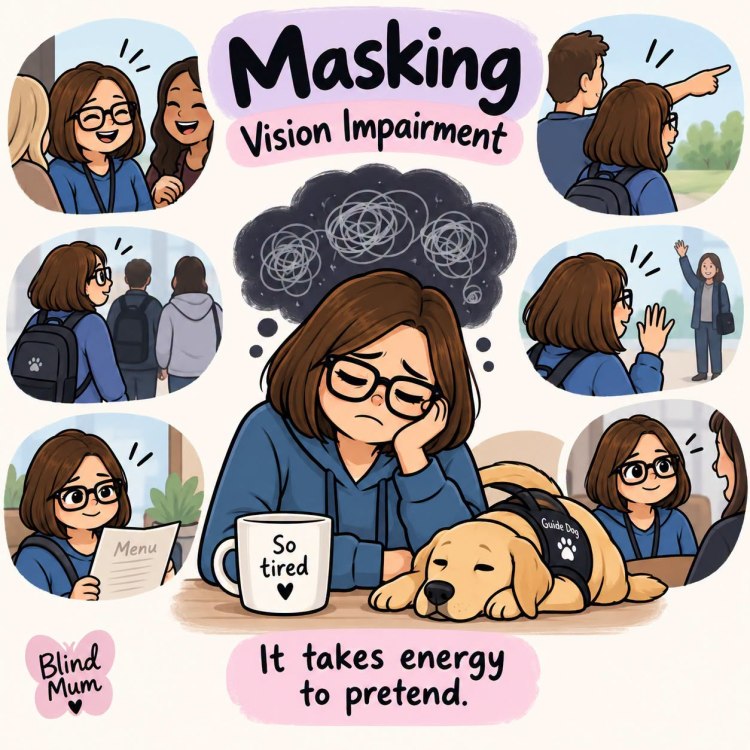
I don’t think we talk enough about how much energy it takes to pretend you can see more than you actually can. Laughing when everyone else laughs because you’re not quite sure what happened. Nodding along when someone points and says, “It’s just over there.” Pretending you’ve spotted the person waving at you. Following everyone else because you haven’t actually got a clue where you’re going. Not asking someone to read something because you don’t want to make a fuss. Trying desperately to work out what you’re looking at before anyone realises you can’t see it. I’ve done all of these. Sometimes it’s easier in the moment to pretend you’ve seen something than explain that you haven’t. But masking takes energy. You’re constantly concentrating. Guessing. Filling in the gaps. Watching what everyone else is doing and using that information to work out what you can’t see. And sometimes you don’t realise just how exhausting that is until you’re somewhere you don’t have to do it anymore. These days I’m much more likely to just say, “I can’t see that.” And honestly, those four words save an incredible amount of energy. Vision impairment isn’t only about what you can and can’t see. Sometimes it’s about how hard you’re working to make sure nobody else notices
This is a copy of an article written by Sam Ralfe – known as Blind Mom – on Facebook. She speaks for the blind and visually impaired, covering the pitfalls and triumphs of daily life, as well as the odd serving of common sense. In her own words, she aims to break barriers in the hope of creating a more inclusive world. As a visually compromised person, I find her writing refreshing, relevant and educational. I hope you do, too.
I love all the hairstreak butterflies but they can be very elusive. We spent many happy hours in Chambers Farm Woods looking for them but weren’t able to get there this year, for various reasons, so I dug this brown hairstreak out of the archives to remind myself how beautiful they are.
Jake Morgan has led a charmed life so far. After a career as a rodeo cowboy where he had his pick of beautiful women, he has now taken over his father’s ranch and is making a success of it. Life can get a bit lonely at times but he has his dog, Luna, to keep him company and, by and large, he has no complaints. Things change for him, however, when he goes into the store to stock up on supplies and beer in order to hunker down in the face of an oncoming storm. On his way home, he encounters a damsel in distress, namely Cassidy Smith, whose car has run into a ditch at the side of the road. With no one available to haul her car back onto the road and seriously under-dressed for the weather, Cassidy has no choice but to accept Jake’s offer of taking her to his ranch where they can ride out the storm.
Of course, a sexual attraction soon grows between the handsome cowboy and the beautiful girl. So far so good. But the past has a nasty way of raising its ugly head and, just as Jake and Cassidy look like they’re heading for a happy-ever- after, Cassidy’s past does just that. Our intrepid pair must work together to save their fledgling relationshipIn Winter Heat, Amanda Sheridan has created two likeable, realistic characters, complete with human flaws. She intertwines their stories perfectly with alternating POV chapters and, once the scene is set, maintains a good pace to the satisfying conclusion. Highly recommended. In the interests of full transparency, I was supplied with a copy of Winter Heat in a format which enabled me to listen to it. Many thanks to Amanda Sheridan.
Go Tell It on the Mountain, James Baldwin Giovanni’s Room, James Baldwin I was introduced to the work of James Baldwin in the 1970s when studying American Literature as part of my first degree. I was initially unenthused at the prospect. I couldn’t imagine being interested in anything written by a black, male, homosexual American. I can no longer remember what that first book was, but I do remember being so taken by Baldwin’s work that I went straight to the library and checked out Go Tell It On The Mountain, his first and highly autobiographical book. It’s no exaggeration to say this novel is a tour de force. Ostensibly, it tells the story of one day in the life of fourteen year old Johnny Grimes. In actuality, it encompasses the histories of his immediate family, delving into previous generations to document their trials, shortcomings and small triumphs as they migrated north to New York in search of a better life. A lot of their stories are rooted in despair and disgrace, yet an optimism for a better future persists, buoyed up by a fierce belief in the religion that holds them together. Not an easy read, in any sense of the word, but powerful, raw and honest.
Giovanni’s Room was ground-breaking at the time of its publication, telling the story of a young man in Paris, struggling to deny his homosexuality, refusing to acknowledge the very real love he feels for the eponymous Giovanni. As homosexuality was illegal at that time in America (although not in Paris) the book was treated as pulp fiction and published with a lurid cover picture of a half-naked man in the background. Again, Baldwin leaned heavily on his own experiences, although portraying the main character as a young, white man.The story doesn’t quite hold together in terms of structure and parts were a bit rushed but, nevertheless, it is both haunting and tragic in places.
Fox, Joyce Carol Oates Oates has always been one of my go-to authors. She can be savage, even brutal – she tore Marilyn Monroe to shreds in Blonde – but I admire her writing style and she’s certainly not afraid to grasp the nettle. However, I came really close to DNFing Fox. It wasn’t so much the subject matter, which has been done many times before – a paedophile teacher abusing his young pupils – but rather the heavy handed repetition that robs the book of its impact. There are multiple characters whose stories are expertly woven into the plot and, in parts, Oates can tug at the heartstrings but, ultimately, the whole thing needed a swingeing edit to remove at least thirty per cent of Oates meandering.
My Dark Vanessa, Elizabeth Russell This novel has an almost identical theme to Fox, this time written from the victim’s point of view in two different timelines. Initially, I thought I had picked up a YA book by mistake until I listened to an interview with the author in which she explained that the book had been many years in the making and the early chapters had been written in her mid-teens. These chapters are heavy with references to books, poems etc. – and, yes, Lolita is instanced many times, as is quite a lot of Nabokov’s other works. Vanessa, as a young girl, is extremely well portrayed although the plot stretched credulity at times. The chapters in which she is an adult are slow and lack energy. A bit of a disappointment in view of the many positive reviews.
The Long Walk, Stephen King (as Richard Bachman) As far as I recall, King wrote four of the Bachman books about fifty years ago. Already a successful author, he wanted to see if he could get published as an unknown author. Turns out he could, but the books bombed – until he was outed and then they sold like hotcakes. I had planned to revisit them but The Long Walk has cured me of that notion. One hundred boys, aged fourteen to eighteen, walk for five days and nights without stopping. The winner gets everything his heart desires for the rest of his life. If a boy falters, for even a moment, he gets a warning. After the third warning, he gets shot. Dead. Only one boy makes it to the finishing line. So, basically, it’s a story of ninety-nine boys walking until they’ get killed. The ending makes no sense whatsoever. Whatever reason King had for writing the Bachman stories, he did prove one thing with this dreadful, depressing book – only Stephen King could get away with it.
Adrift, Will Dean
Penny and Drew live in a narrow boat on a canal and it’s obvious from the very beginning that he is a nasty piece of work, controlling both Peggy and their fourteen year old son, Samson, by a toxic mixture of fear and gaslighting. Depriving them of food, moving the boat further and further away from amenities and human contact. In addition to the unremitting misery of his home life – he doesn’t even have bed – Samson is being bullied at school. Dean sketches in his characters in so much gruelling detail that they become caricatures of themselves as Drew piles on evil deed after evil deed and his wife and son abjectly accept everything he throws at them. And yet Peggy works in a library and has written a novel while Samson is highly intelligent with a wealth of knowledge on a variety of subjects. I couldn’t get behind any of the characters apart from wanting to shake Peggy and Samson for submitting to the ludicrous cartoonish Drew.
I’ve reached the stage where I can no longer see the keypad on my laptop. A bit of a blow as my main computers are upstairs and I like working on my laptop in the evenings. Then I hit on the idea of balancing my big button keyboard on my laptop and hey presto! I can still relax in my armchair with my laptop on my knee.
For readers/listeners of a certain age, this book is a trip down memory lane. Otto Penzler has assembled a sterling selection of short stories from the years between the two world wars. Each story is preceded by a potted biography of the author, many of whom have legendary film credits to their name – a great touch that really holds the book together. The stories are of their time time but not dated. Each one is as fresh as if it were written yesterday and each one has a well thought out plot and a satisfying denouement. I particularly enjoyed the stories by Ellery Queen and Pearl S. Buck and would recommend this book. #netgalleyence.
Never Forgive You is listed as a suspense thriller and it certainly is, but it’s much more than that. The author has assembled quite a large group of characters in her French setting and also uses two different points of view to tell her story – devices which can be quite challenging when trying to hold the reader’s attention. In this instance, they not only work admirably but, in my opinion, enhance the tension as we see events through two differing interpretations.
It’s a story of murder and revenge, served stone cold, and is teased out with nail-biting anticipation. or sent me off in a different direction before the whole thing was brought to a I believed I had pinpointed the perpetrator early on but a clever little nudge from the auth satisfying conclusion. This is the second book I have read by Hilly Barmby and will definitely be seeking out more.
July 08, 2026 Three years ago, Jan began to build a garden in our small backyard. She was constrained to using plant pots and troughs and her plan was to incorporate as many wild flowers as possible to attract insects to our urban area. In between them, she added a variety of cottage garden flowers and all her hard work paid dividends this year. Among the wildflowers she has at the moment are cornflowers, musk mallow, verbena, fox and cubs, wild wallflowers and red valerian. Interspersed with these, she has chosen petunias, impatiens, fuchsia, hydrangea and foxgloves. For me, the bonus is that, after all Jan’s hard work, I get to relax in the cool of the evening with a gin and tonic in the wonderful world she has created.
SHADOWS OF THE PAST HANG HEAVILY ON THREE RUNAWAYS WHO FACE THEIR GREATEST FEARS JUST WHEN THEY THOUGHT THEY’D EARNED A NEW LIFE.
Jilly Graham knows what it is to be used and abused. She also knows how to get what she wants. Poised to achieve a First Class Honours degree, it seems the world is at her feet and she has buried the memory of what she did to pay for her education. For three years, Jilly has lived with Rob Knowley, a loveless relationship, but when she begins a project documenting the lives of local sex workers, Rob becomes violent and abusive and her future and past violently collide. Tina Lloyd has been a sex worker since she was fourteen years old and craves a normal family life, although in her heart she knows she is only one of the women her husband, Noel, controls. Their son, Leon, hates both his parents and is tormented at school because of Tina’s profession. When Jilly allows a photograph of Tina to be published without Tina’s consent, it sets off a series of violent acts which eventually lead to an horrific murder. In the aftermath, Jilly, Tina and Leon are thrown together as fugitives. Living together in close confinement, none of them trusting the others, this fragile group opens up to one another and brutally honest truths emerge.